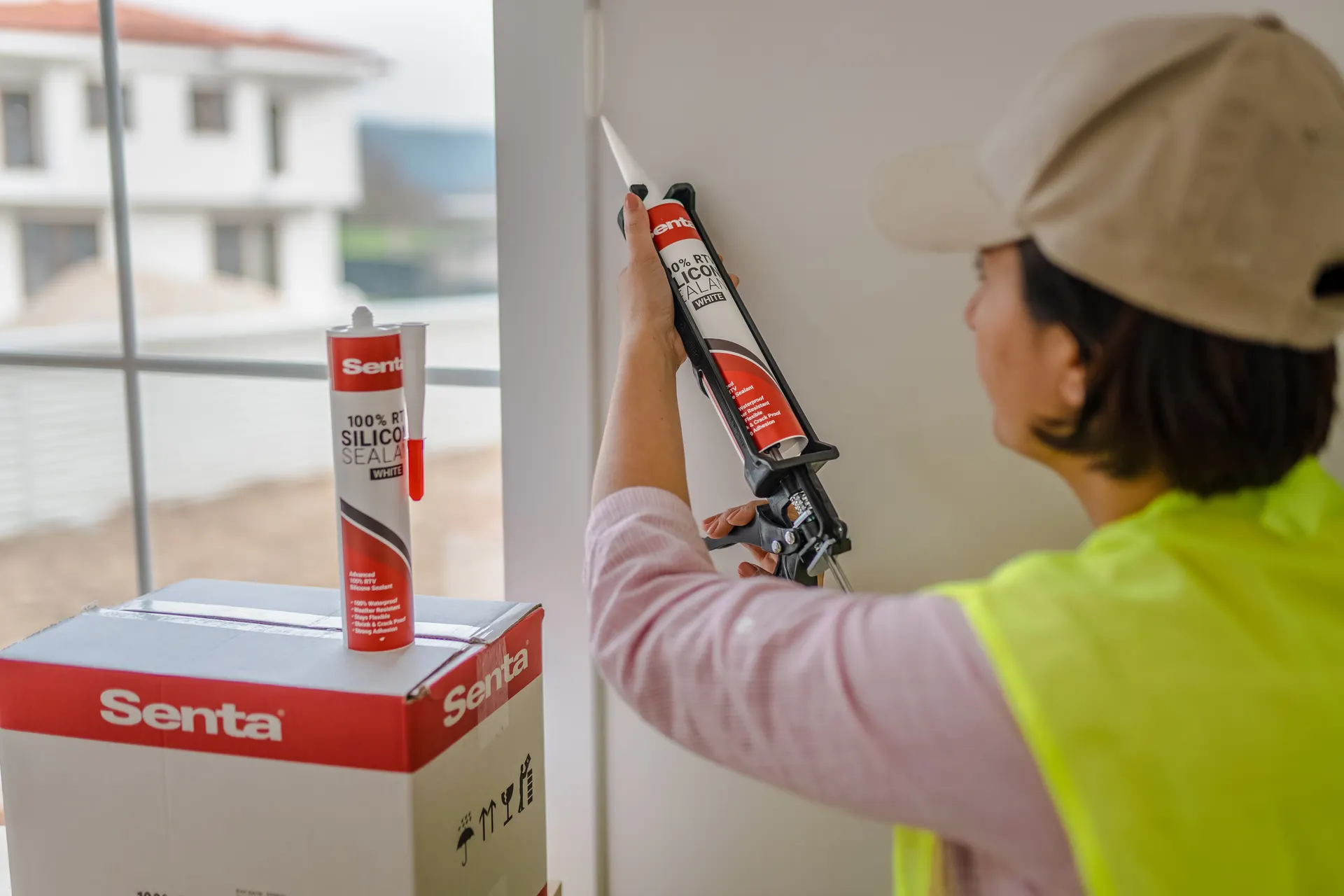
Choosing a sealant for glass and aluminum

For most weather-sealing and bedding joints, the usual sealant for glass and aluminum is a 100% silicone: it bonds well to both, stays flexible through heat and cold, and resists UV. Look for a non-sag, ASTM C920-rated product with a movement class that fits the joint, prep both surfaces carefully, and check the data sheet for any coatings or nearby materials it shouldn't touch.
What a sealant for glass and aluminum has to handle
Glass and aluminum are both smooth and non-porous, which makes them easy to clean but unforgiving if prep is poor. The joint between them also moves. Aluminum expands and contracts noticeably with temperature, while glass moves much less. A sun-facing storefront or window frame can go from cold morning to hot afternoon every day.
So the sealant needs:
- Strong adhesion to both materials
- Flexibility and movement capability so the bond doesn't tear as the frame moves
- UV and weather resistance for exterior and sunlit joints
- Non-sag body so it stays in vertical joints
- Compatibility with gaskets, coatings and other materials it touches
Why 100% silicone fits glass and aluminum
Senta 100% RTV Silicone lines up with those needs:
- Adhesion to glass, aluminum, metals, wood and most common non-porous building materials
- UV and weathering resistant; stays flexible from extreme cold to extreme heat
- Joint movement of ±25 % (ASTM C920 Type S, Grade NS, Class 25)
- 0 in sag on vertical and overhead joints (ISO 7390)
- Tensile strength ≥ 215 psi and elongation at break ≥ 350 % (ASTM D412)
- Service temperature of -62 °F to 400 °F (450 °F intermittent)
- CE EN 15651 classification for façade, glazing and sanitary use
Clear keeps the joint nearly invisible against glass; White or Translucent White can match white frames. Our guide to clear, white or translucent silicone helps you choose.
Where to be careful
A sealant for glass and aluminum isn't automatically right for every glass or metal job.
- Mirrors. Acetoxy (vinegar-smell) silicone can attack mirror backing. Senta silicone should not be used on mirrors; use a product made for mirrors.
- Sensitive metals. Don't use acetoxy silicone on copper, brass, lead or other sensitive metals, which can corrode or discolor.
- Gaskets and rubbers. Senta silicone is not for use with bitumen, neoprene and certain organic elastomers. If the frame has rubber gaskets, check what they're made of.
- Coated or anodized aluminum. Finishes vary. Clean thoroughly and do a small adhesion test before a large job.
- Structural glazing and insulated glass units. Bonding glass as a structural element, or sealing the edge of an insulated unit, are engineered applications with their own specified materials and procedures. This guide is about weather seals and bedding joints.
- Neighboring porous surfaces. If one side of the joint is concrete, brick or natural stone, Senta silicone isn't recommended on that side.
- Painting. 100% silicone isn't paintable. Choose the color up front.
Tools and materials
- 100% silicone sealant
- Caulking gun
- Lint-free cloths
- Isopropyl alcohol
- Razor scraper (for glass only)
- Painter's tape
- Backer rod for deeper joints
- Tooling spatula
- Gloves and safety glasses
How to seal glass to aluminum
- Check the conditions. Apply between 40 °F and 105 °F, on dry surfaces. Avoid frost or condensation on the glass.
- Remove the old sealant. Cut it out and scrape the glass with a razor scraper held flat. On aluminum, use a plastic scraper to avoid scratching the finish.
- Clean both surfaces. Use the two-cloth method: wipe with a cloth dampened with isopropyl alcohol, then wipe dry with a clean cloth before the solvent evaporates. Change cloths often.
- Set the joint depth. Use backer rod so the sealant depth is about half the joint width. For joints 0.24–0.47 in wide, Senta recommends a 0.24 in depth, with a minimum of 5 × 5 mm.
- Tape the edges. Painter's tape on the glass and the frame gives a clean, straight line.
- Apply. Push a continuous bead into the joint so it fully contacts both sides.
- Tool within 5 minutes. Press and smooth the bead in one pass, then pull the tape immediately.
- Ventilate and let it cure. Keep air moving while the vinegar smell clears. Senta silicone cures at about 1/8 in of depth per 24 hours; avoid washing the glass over the joint until it has cured.
For more on window perimeters, see how to caulk windows.
FAQ
Is silicone the right sealant for aluminum window frames?
For weather-sealing joints between aluminum frames and glass or other non-porous surfaces, 100% silicone is a common choice because of its adhesion, flexibility and UV resistance. Check the frame maker's instructions for any specific requirements.
Can I use acetoxy silicone on a mirror?
No. Acetoxy silicone can damage mirror backing. Use a sealant or adhesive made for mirrors.
Do I need a primer on glass or aluminum?
Clean, bare glass and aluminum usually just need thorough cleaning. For coated or unusual finishes, test adhesion first and check the technical data sheet.
For glass and aluminum joints, take a look at Senta 100% RTV Silicone in Clear.