Caulking in hot weather and direct sun

Caulking in hot weather works if the surface, not just the air, is within the sealant's application range. For Senta sealants that range is 40–105 °F, and a wall in direct summer sun can be far hotter than the air around it. Work in the shade or early in the day, plan for a shorter skin time, and tool quickly.
Why caulking in hot weather is tricky
Heat changes three things at once:
- The surface gets hotter than the air. Dark siding, metal flashing and aluminum frames in full sun can run well above the air temperature. If the forecast says 95 °F, the surface you're caulking may be over the 105 °F limit.
- The sealant skins faster. Moisture-curing silicone reacts faster in warm, humid conditions. Senta silicone's skin time is 8–20 minutes at 70 °F and 50 % relative humidity; on a hot, humid day, expect the short end or less. Once a skin forms, tooling drags and tears it.
- The joint is at its narrowest. Building materials expand in heat, so gaps close up on hot afternoons. A bead applied into a squeezed joint gets stretched hard when the joint opens again in cold weather.
None of these mean you can't caulk in summer. They mean timing and technique matter more.
Check the surface, not the thermometer
A cheap infrared thermometer takes the guesswork out. Point it at the actual joint. If you don't have one, a simple rule: if the surface is too hot to keep your palm on comfortably, it's too hot to caulk. Wait for shade.
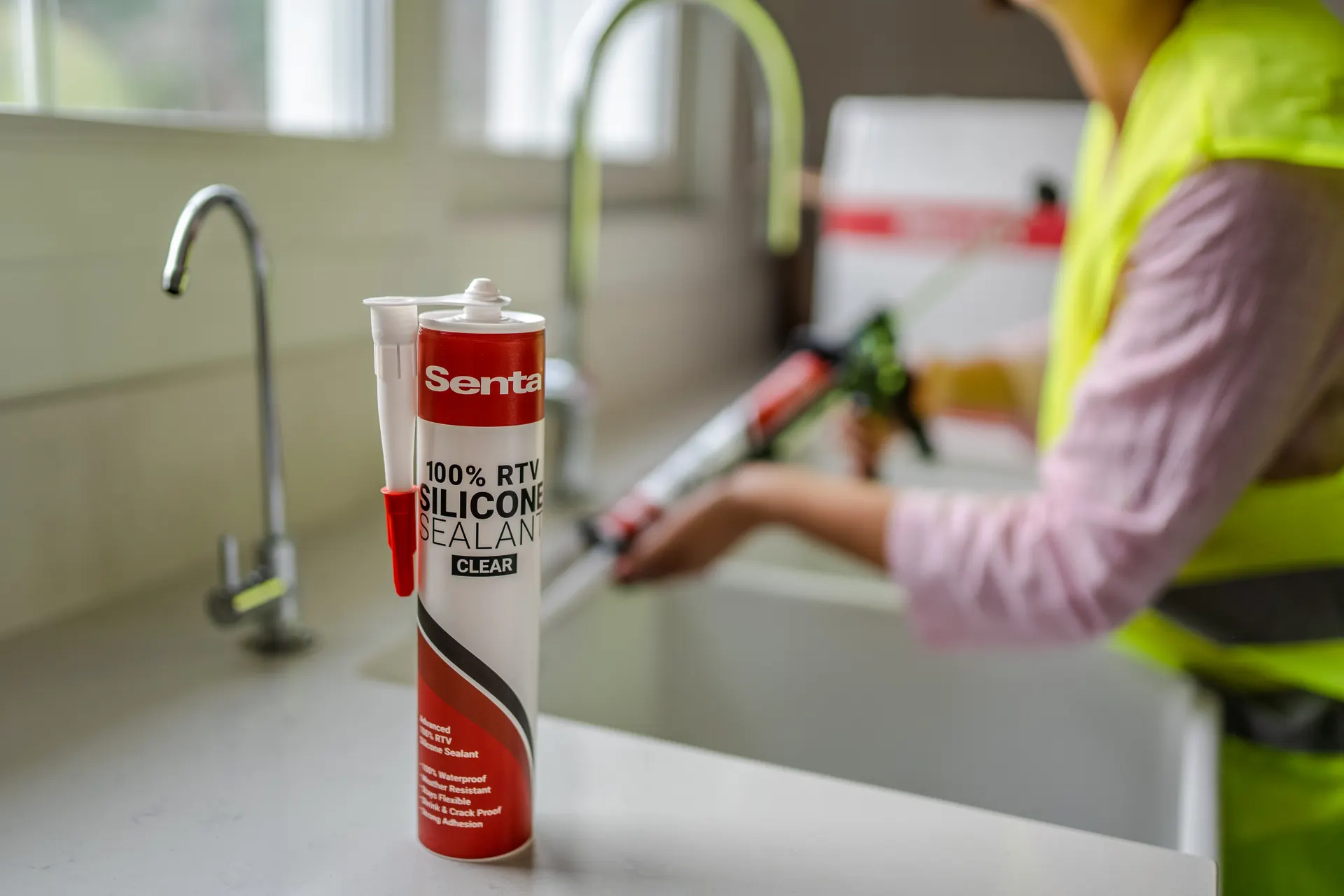
Both Senta 100% RTV Silicone and Senta Siliconized Acrylic Latex Caulk list an application temperature of 40–105 °F.
Plan the day around the sun
- Follow the shade. Work the east side of a building in the afternoon and the west side in the morning. South-facing walls are usually easiest early in the day.
- Avoid the hottest hours. Late morning to late afternoon is when surfaces peak.
- Mild days are ideal. For joints that move a lot, sealing on a moderate day, when the gap is near the middle of its range, spreads the stretch and squeeze more evenly across the seasons.
Tools and materials
- Infrared thermometer (optional but handy)
- Caulking gun
- Sealant, kept cool and out of the sun
- Tooling spatula or spoon, and a damp rag for acrylic caulk cleanup
- Painter's tape
- Clean rags and isopropyl alcohol (for silicone joints)
- Hat, water, gloves and safety glasses
How to caulk in hot weather, step by step
- Keep cartridges cool. Don't leave them on the dashboard or in a truck bed in the sun. Store them in a shaded spot or a cooler (without ice touching them). Hot sealant flows faster and can run out of the nozzle.
- Prep in sections. Clean and tape only as much joint as you can caulk and tool in a few minutes. Dust and pollen settle quickly on a hot, breezy day.
- Work short runs. Instead of running a long bead and then going back to tool it, lay 2 to 3 feet, tool it right away and move on. With Senta silicone, tool within 5 minutes; in heat, sooner is safer.
- Pull tape immediately. Remove painter's tape right after tooling, while the bead is still wet, so the edge doesn't tear as a skin forms.
- Let it cure undisturbed. Senta silicone cures at about 1/8 in of bead depth per 24 hours. Keep pressure washers and sprinklers off the area until it has cured.
Silicone vs. acrylic in the heat
- 100% silicone stays flexible from extreme cold to extreme heat once cured, with a service temperature of -62 °F to 400 °F (450 °F intermittent) and UV and weathering resistance. That makes it a good fit for sunny exterior joints on glass, metal, aluminum and other non-porous surfaces.
- Siliconized acrylic latex is weatherproof after curing and suits porous surfaces like brick, stucco, concrete and wood. In strong sun and wind, its surface can dry quickly, so work in short sections. Keep the joint dry for at least 2 hours after application, and check for afternoon storms.
For the full picture on choosing between them, see silicone vs. acrylic caulk.
Stay safe in the heat
Acetoxy silicone gives off a vinegar smell while curing, so keep air moving in enclosed spaces. Outdoors, the bigger risk is you: drink water, take breaks in the shade and be careful on ladders when you're tired. Wear gloves and safety glasses, especially when cutting out old caulk overhead.
Working in the opposite season? Read caulking in cold weather.
FAQ
What is the maximum temperature for caulking?
For Senta silicone and Senta acrylic caulk, the application range tops out at 105 °F. That limit applies to the surface as well as the air.
Does hot weather make caulk cure faster?
Warmth and humidity speed up the skin forming on moisture-cure silicone. The bead still cures inward over time; Senta silicone cures at about 1/8 in of depth per 24 hours.
Can I caulk in direct sunlight?
You can if the surface stays within the application range, but shade is easier. Direct sun shortens your working time and can push dark or metal surfaces past 105 °F.
For sunny exterior joints on non-porous surfaces, look at Senta 100% RTV Silicone.