How long does silicone take to cure?
Silicone sealant skins over in minutes but cures from the outside in, slowly. Senta 100% RTV Silicone forms a skin in 8 to 20 minutes and cures at a rate of 1/8 inch bead per 24 hours (at 70 °F and 50 % relative humidity). So a thin 1/8 inch bead needs about a day, while a deeper bead takes proportionally longer.
Knowing the stages helps you plan when to tool, when to remove tape and when the joint can get wet.
The stages of silicone curing
1. Working time (tooling window)
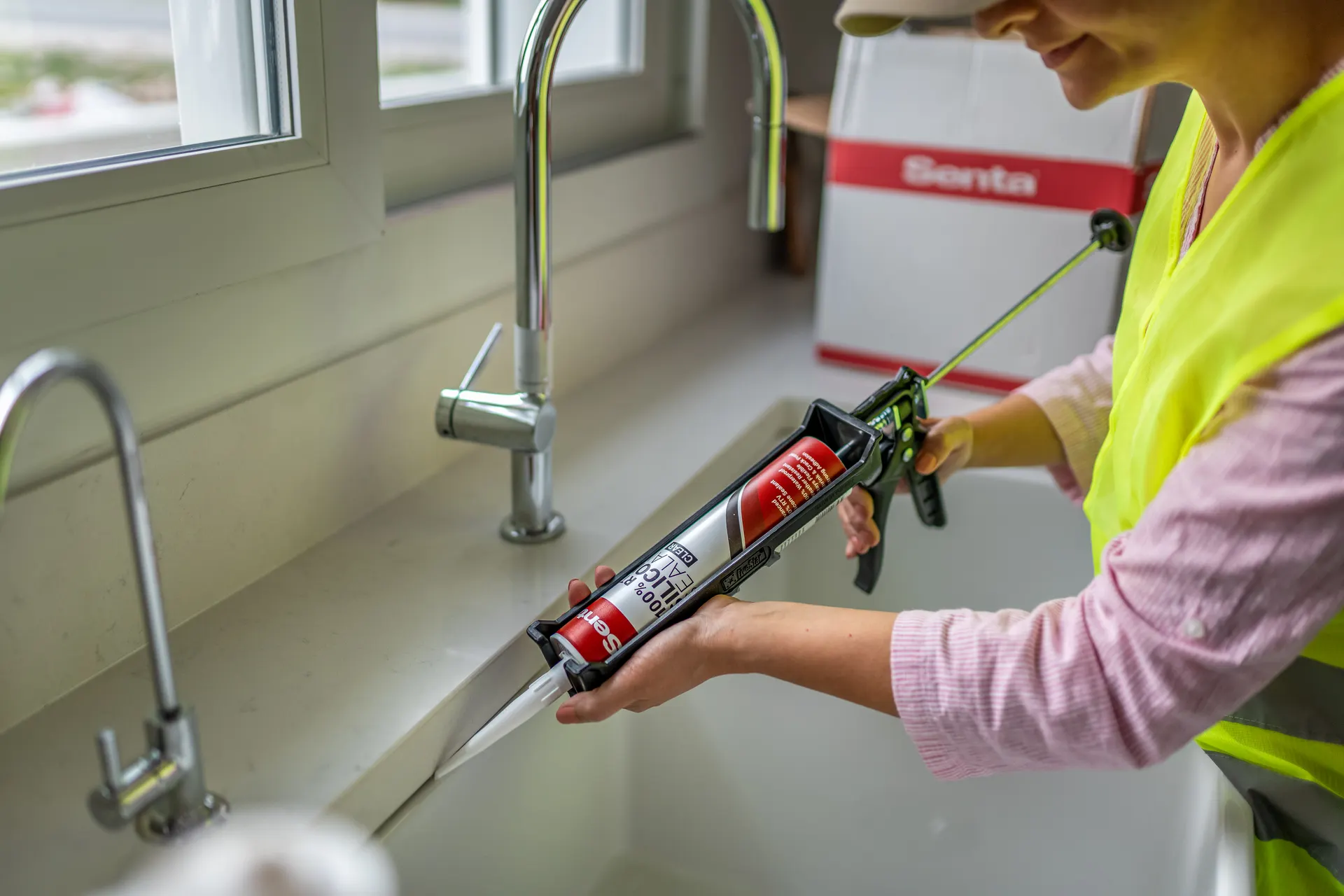
Right after you apply it, silicone is soft and workable. This is when you smooth the bead and press it into the joint. For Senta silicone, tool within 5 minutes. After that, the surface begins to form a skin and tooling drags and wrinkles it.
2. Skin time
The surface reacts with moisture in the air and forms a thin skin. Senta's skin time is 8 to 20 minutes at 70 °F and 50 % relative humidity. Once skinned, the bead is no longer sticky to a light touch, but it is still soft underneath. Dust and light contact won't stick to it, yet it is far from ready for use.
3. Cure through the bead
Curing moves inward from the skin; Senta's published cure rate is a 1/8" bead per 24 hrs under standard conditions (70 °F, 50 % RH). Deeper joints take longer than that, and cool or dry air slows curing further.
4. Final properties
Silicone keeps developing its final properties for a while after it has cured through. Senta lists its Shore A hardness of 15 to 25 as measured after 28 days. For normal household use, you don't need to wait that long, but it shows the sealant is still settling after the first few days.
What affects how long silicone takes to cure
Because RTV silicone is a moisture cure, three factors matter most:
- Bead depth. Cure moves inward at a steady rate, so depth matters more than width. This is one reason to size joints correctly and use backer rod in deep gaps. See our guide on joint size and backer rod.
- Humidity. More moisture in the air generally speeds curing; very dry air slows it.
- Temperature. Cool temperatures slow the reaction. Senta silicone should be applied between 40 °F and 105 °F. In cold weather, plan for longer cure times, as covered in caulking in cold weather.
Air also has to reach the sealant. Silicone sandwiched in a sealed space, or applied in a totally confined area, cannot cure properly. Senta silicone is not intended for totally confined spaces.
When can it get wet?
Senta 100% RTV Silicone's published cure rate is a 1/8" bead per 24 hrs (at 70 °F, 50 % RH). Silicone cures from the surface inward, so deeper beads need more time than that — and a cool or dry room slows things down further. Check the technical data sheet and ask our team if you are sealing an unusually deep joint.
For a shower or tub, wait at least 24 hours for a typical bead before using it, and longer if the bead is deep or the room is cool or dry. When in doubt, give it extra time. Water on a partly cured bead can leave marks or weaken the seal.
Can you speed it up?
Within reason:
- Ventilate. Fresh air brings in moisture and carries away the vinegar smell of acetoxy silicone.
- Keep the room at a comfortable temperature. Avoid very cold rooms.
- Don't over-apply. A properly sized bead cures faster than an oversized one.
Avoid using heat guns or hair dryers on fresh silicone. Direct heat can dry out the surface or cause bubbles without curing the interior faster.
What about acrylic latex caulk?
Siliconized acrylic latex caulk cures differently. It is water-based and cures as water evaporates. For Senta Siliconized Acrylic Latex Caulk, keep the joint dry for at least 2 hours after application, and don't apply it if rain or frost is expected. It can be painted after it has cured; check the product's data sheet on our technical documents page for details.
Signs the silicone is cured
- The bead feels firm and rubbery, not soft, when pressed gently at the edge.
- The vinegar smell has mostly faded.
- A fingernail mark at the edge springs back instead of leaving a dent.
For bathrooms and kitchens, Senta 100% RTV Silicone in White follows the same cure rate of 1/8 inch bead per 24 hours.
FAQ
How long before silicone is waterproof?
The skin forms in 8 to 20 minutes, but the bead should cure through before regular water exposure. For Senta silicone, that is about 24 hours for a 1/8 inch bead.
Does silicone cure faster in heat?
Warmth and humidity help, but only within the application range of 40 °F to 105 °F. Very dry heat or direct heat sources can cause problems rather than speed the cure.
Why is my silicone still tacky after a day?
Common causes are a very thick bead, cold or dry air, poor ventilation, or applying over a contaminated surface. Give it more time; if it never cures, remove it and start over.